
Photo by Laura Chouette on Unsplash
When we hear the word well-being, it is easy to think of happiness.
Maybe we picture someone who regularly posts pictures smiling with friends, has a good job, and seems to have life figured out. But real well-being is much more nuanced than simply feeling happy.
In positive psychology, well-being involves the conditions and experiences associated with a meaningful, satisfying, and productive life. In contrast to classic psychology where the focus is primarily on what goes wrong, positive psychology asks a deeper question: What helps people flourish and thrive?
This perspective fits naturally with holistic health because our emotional, physical, social, and behavioral lives do not exist in separate, isolated boxes. As Walt Whitman would say – we contain multitudes.
What Exactly Is Well-Being?
Well-being refers to a person’s overall psychological, emotional, social, and physical functioning and their perception that their life is going well. It is a multidimensional concept that includes positive and negative emotions, psychological functioning, meaningful relationships, purpose, and a sense that one’s life is worthwhile.
Compton and Hoffman (2019) describe positive psychology as the study of the conditions that allow people to experience happiness and flourishing. However, well-being and flourishing are not necessarily identical.
Well-being does not mean feeling happy all the time or avoiding negative emotions. A person may experience grief, frustration, stress, or disappointment while still maintaining meaningful relationships, pursuing valued goals, and experiencing purpose and a sense of direction in life.
In this sense, well-being is better understood as an overall pattern of healthy functioning and meaningful engagement with life rather than as a constant emotional state.
Well-being is also not necessarily fixed. Solanes et al. (2021) reviewed research on interventions intended to increase subjective well-being and found evidence that well-being can be improved, although the strength of evidence differs across interventions. This suggests that well-being can be influenced by behaviors and circumstances rather than being entirely predetermined. For example, Burke and Dunne (2022) found significant associations between six lifestyle-medicine areas – sleep, physical activity, healthy eating, alcohol-related behaviors, social engagement, and stress management – and psychological flourishing. Because their study was cross-sectional, however, these findings show associations rather than demonstrating that these behaviors caused greater flourishing.
Overall, well-being can therefore be understood as a broad and dynamic state of healthy psychological, social and physical functioning that involves more than simply feeling happy.
The Internet, Social Media, and the Stress of Always Being Connected

Photo by Mindfulness Com on Unsplash
Technology has made many parts of life easier. We can stay connected with family members across the country, find communities based on shared interests, learn almost anything online, and access support that may not be available locally. At the same time, being connected all the time can create its own type of stress.
Khetawat and Steele (2023) examined several components of digital stress, including fear of missing out (FOMO), approval anxiety, connection overload, availability stress, and online vigilance. Their meta-analysis found that these forms of digital stress were associated with real psychosocial distress. For example, to combat FOMO, someone may repeatedly check social media because they are worried that they are missing an event, conversation, opportunity, or piece of information. Social comparison can be just as problematic. Social media feeds often show vacations, celebrations, career achievements, relationships, fitness progress, and other carefully selected moments.
Even when we know that curated content does not show the whole story of someone’s life, it can still be difficult not to compare.

Photo by Elisa Ventur on Unsplash
Research suggests that the relationship between social media and well-being is more complicated than simply asking how much time someone spends online. Marciano et al. (2024) reviewed 78 studies and found that different types of social-media use had different relationships with well-being.
Communication and positive online experiences were associated with some positive outcomes, while problematic use and social comparison were negatively associated with well-being. This distinction is particularly useful for applied psychology and holistic health. Instead of simply telling someone to “spend less time online,” it may be more helpful to ask how they are using technology and how they feel afterward. For one person, social media might increase anxiety. For another, an online community may provide meaningful connection and support.
Practical changes might include turning off unnecessary notifications, establishing a screen-free period before bed, or intentionally following accounts that encourage rather than undermine well-being.
The goal is not necessarily to eliminate technology. It is to make technology work for well-being instead of allowing it to quietly work against it.
PERMA: Five Pieces of a Flourishing Life
One of the best-known models in positive psychology is Martin Seligman’s PERMA model which describes five elements associated with well-being and flourishing: positive emotion, engagement, relationships, meaning, and accomplishment (Compton & Hoffman, 2019).
The model reminds us that well-being is not just about asking, “Am I happy?” It encourages us to consider several different areas of life.
Positive emotion includes gratitude, joy, hope, interest, and contentment without requiring us to ignore difficult emotions.
Engagement refers to becoming deeply involved in an activity. Gardening, painting, exercising, cooking, reading, or working on a meaningful project can all provide opportunities for engagement.
Relationships recognize the importance of human connection, including belonging, encouragement, emotional support, and companionship.

Photo by Desiray Green on Unsplash
Meaning involves having a sense of purpose and feeling that life matters – often from activities with family, spirituality, work, creativity, service, community involvement, or personal values.
Accomplishment involves pursuing goals, developing competence, and experiencing progress through meaningful achievements.
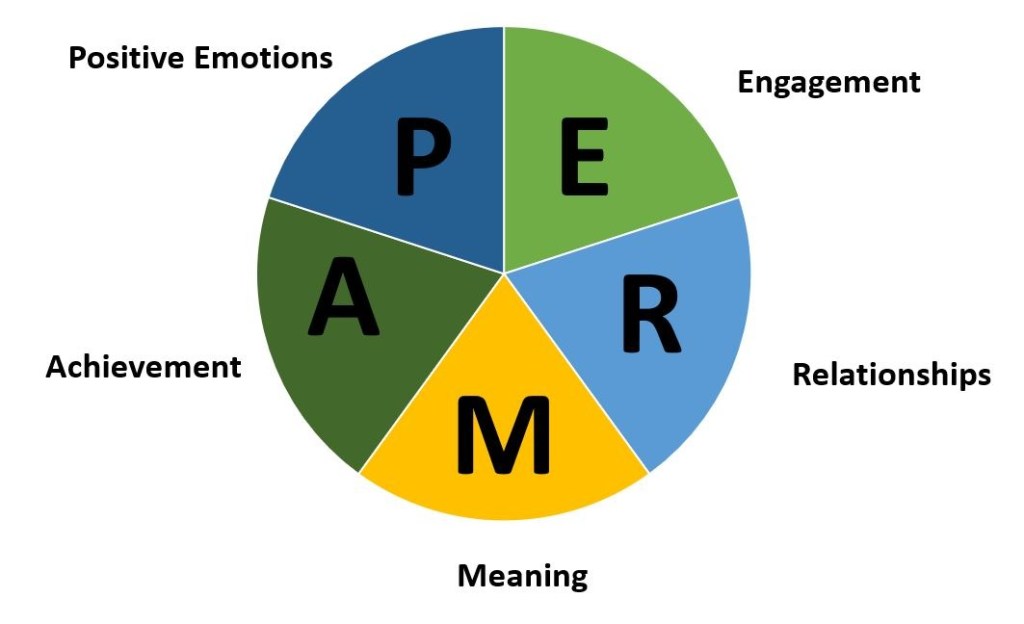
The PERMA framework provides a foundational understanding of well-being as being multidimensional rather than as simply a measure of how happy someone feels.
From Freud to Positive Psychology: Why Theory Matters
Positive psychology developed within a much longer history of psychological theories and research. Earlier approaches, including psychoanalytic, humanistic, cognitive, and behavioral psychology, contributed different ways of understanding human thoughts, emotions, development, and behavior.
These traditions demonstrate why theoretical, or basic, research matters. Basic research is generally concerned with understanding psychological processes, developing concepts, testing theories, and expanding knowledge.
A researcher might investigate why people behave in certain ways without immediately developing an intervention; however, this knowledge can eventually inform practical solutions.
When Psychology Moves From Theory to Real Life
Applied research uses psychological knowledge to address practical problems. Instead of asking only, “How does this process work?” researchers may ask, “Can we use what we know to help people?”
McTiernan et al. (2022) reviewed studies on positive psychology interventions and their effects on subjective well-being and depression. Their findings serve as an important reminder that applied psychology needs to remain evidence-based.
It can be tempting to hear about a positive psychology exercise and assume that it will work for everyone. Gratitude, positive thinking, and goal setting may sound simple, but interventions still need to be studied rather than assumed to be universally effective.
Wu (2021), for example, examined the “Three Good Things” intervention and found that affect played a mediating role in the relationship between the intervention and depression and well-being. This provides an example of researchers investigating not only whether an intervention is associated with an outcome, but also how it may work.
Theory gives researchers something to investigate. Applied research tests whether those ideas hold up when they are used in real situations.
Bringing Positive Psychology Into Holistic Health
Positive psychology can be especially useful when combined with lifestyle medicine because both approaches recognize that well-being is influenced by multiple, interconnected aspects of life.
Imagine a client who is feeling stressed, disconnected, and unmotivated. A holistic approach could consider sleep, physical activity, relationships, digital habits, engagement, and the person’s values and goals.
The PERMA framework provides another way to explore these areas by considering relationships, engagement, meaning, and accomplishment alongside positive emotions.
Rather than assuming that one intervention will work for everyone, a practitioner could explore which areas may be contributing to a person’s difficulties. Someone struggling with stress might benefit from examining sleep and stress-management habits. Someone experiencing loneliness might explore ways to strengthen relationships. Someone who feels stuck might consider meaningful goals and achievable accomplishments. Someone who spends hours scrolling through social media might benefit from changing their digital habits.
There is no single “well-being prescription” that works for everyone. That may be one of the most useful lessons positive psychology offers as it helps personalize interventions based on individual strengths and goals.
Living Well Is About More Than Feeling Good

Photo by Brett Jordan on Unsplash
Positive psychology gives us a broader way of thinking about health. Rather than focusing only on the absence of mental illness or the presence of happiness, it considers the multidimensional factors that contribute to a fulfilling life. It can involve positive emotions, engagement, relationships, meaning, and accomplishment, alongside physical health, and the ability to respond to life’s challenges.
PERMA provides one framework for understanding those dimensions, while applied research helps us determine which strategies may actually support them.
The Internet and social media make this conversation even more relevant. Technology can connect us, educate us, and give us access to communities and resources. It can also contribute to digital stress and social comparison. Current research suggests that the relationship between social media and well-being depends on more than simply the number of hours someone spends online. How people use technology and what they experience while using it matter too.
For holistic health-based lifestyle design, this creates an opportunity to think beyond isolated habits.
Maybe well-being is not about finding the perfect routine.
Maybe it is about creating a life that has room for rest, movement, connection, purpose, enjoyment, and progress – and being willing to adjust when something is no longer working.
Psychological theory helps us understand why people function and flourish in different ways. Applied research helps us test what actually helps in the real world.
When those two are brought together, positive psychology becomes more than a theory about happiness.
It becomes one possible framework for helping people build healthier, more connected, meaningful lives.


Leave a Reply